
Wellet reads your loved one's records, notices what changed since last time, and drops those patterns into the timeline at the date they actually happened. So you walk into every visit knowing what to ask.
Try the demo (opens in new tab)Or take the 60-second quiz: What Wellet would notice for your loved one →
Just for yourself? Wellet for you →
Most apps surface a pattern at the top of a feed the moment they detect it. Wellet places each CareSignal at the date the pattern actually began — right next to the labs, visits, and notes that drove it. So when you look back, you see the story unfold in order.
Open Wellet and scroll. You see what's new since the last visit and what Wellet noticed in between — in the order it happened.
Hand the doctor the dates. "Her steps dropped four days after the new dose" is more useful than "she's been tired."
Patterns stay anchored in time. Six months from now you can still see exactly when a trend started and what came before it.
A new layer · Caregiver pay
Four federal and state programs reimburse family caregivers when a loved one's diagnosis or coverage qualifies. Most caregivers never hear about them. Wellet surfaces them inside the chart you already manage — with the eligibility criteria written in plain language.
VA · Veterans
Up to $2,500/month tax-free to the caregiver of a service-connected veteran with an ADL need.
Medicaid · State
Up to $1,100/month in NC (varies by state) when the loved one is on Medicaid and meets nursing-home level of care.
Medicare · Dementia
Up to $2,500/year respite plus a clinic care navigator for families with a dementia diagnosis (F01–F03, G30).
Medicare · Any plan
Billing codes (96202, 97550, G0541) any clinician can use to bill Medicare for training a family caregiver — on any care plan.
Wellet does not pay caregivers and does not promise program approval. We surface eligibility signals and prefill the supporting documents you'll send to VA, Medicaid, or the clinic billing office.
Every health tool points at "me." Caregiving points outward. Wellet is the first health platform designed for the person holding someone else's chart.
Connect to your loved one's electronic health records through SMART on FHIR. Labs, visit notes, and medication changes flow in automatically — no more logging into three patient portals.
Beyond the chart, Wellet watches for pattern shifts across wearables, uploads, and the moments your family captures. Passive home sensors — coming soon — will add another layer by witnessing daily routines (not cameras). When something changes, you'll know.
Upload a discharge summary, lab result, or visit note. Wellet reads it, pulls out what changed, and gives you a plain-language summary you can actually act on.
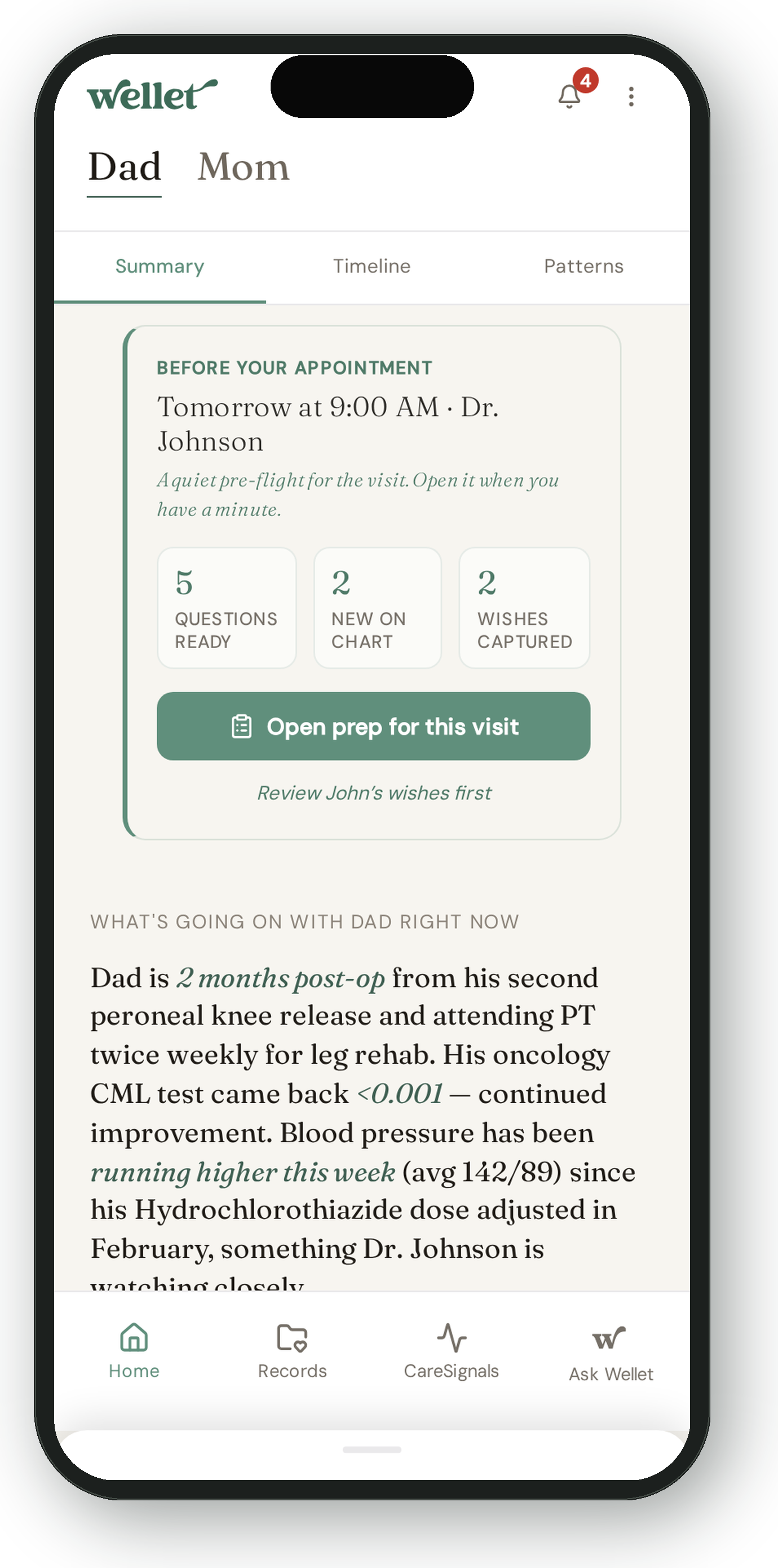
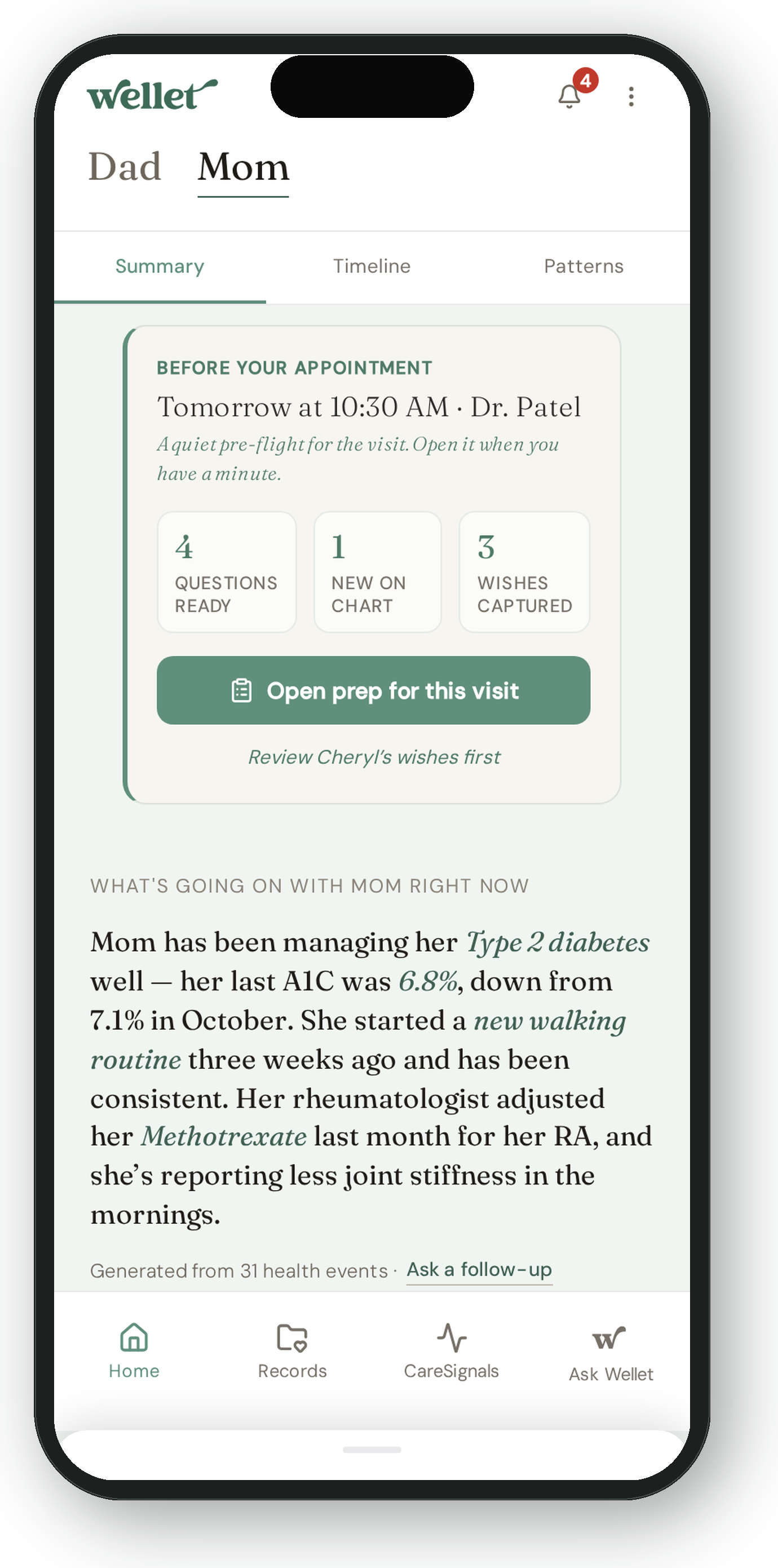
The day before a visit, Wellet quietly gets you ready: the questions you've already saved, what's new on the chart, and the wishes you'll want in your pocket when you walk in.
Recurring · Wellet noticed
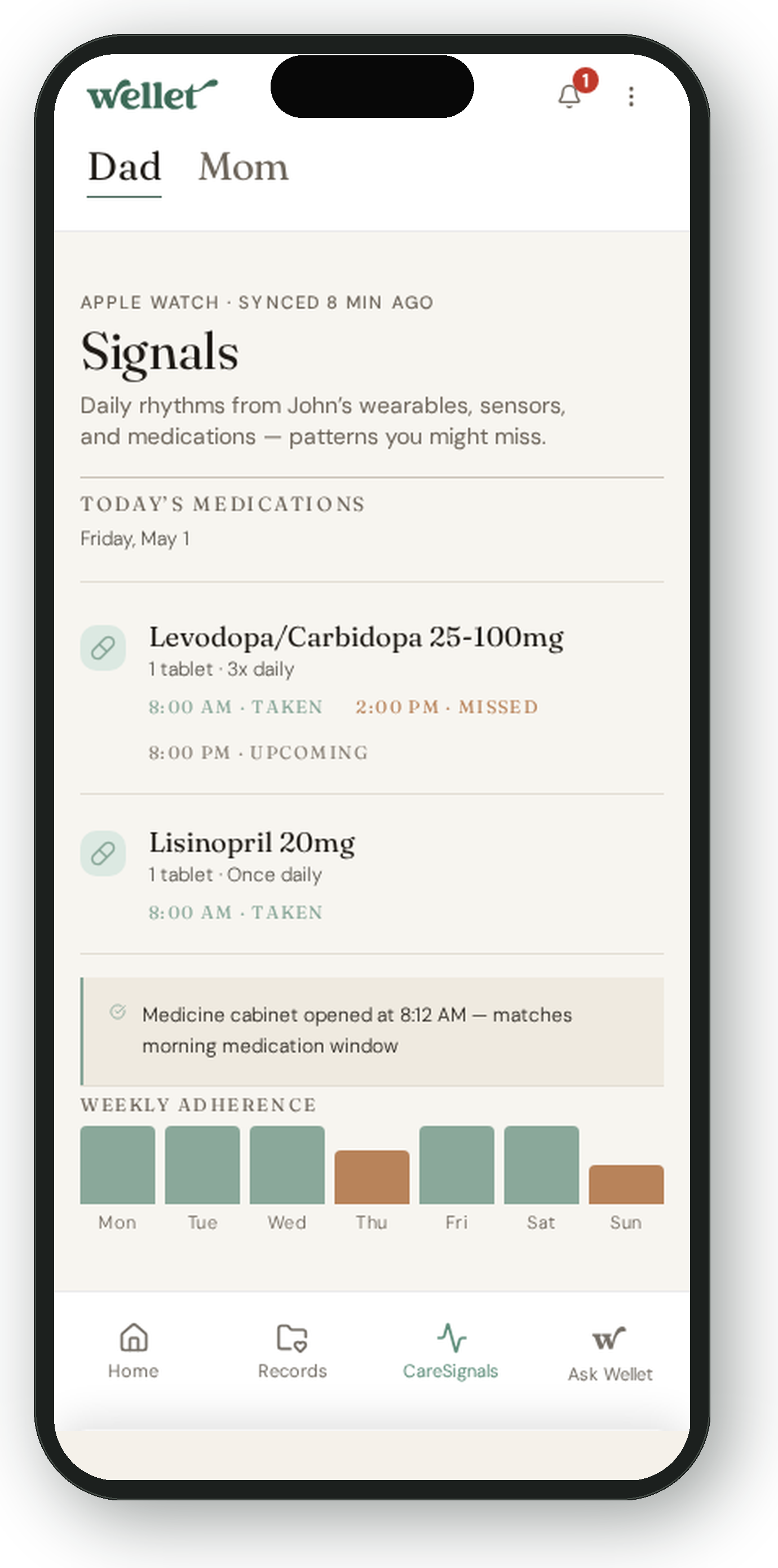
"Blood pressure runs higher in the morning." "Lisinopril is being missed on Sundays." Wellet is noticing the shapes a caregiver would only catch after weeks of MyChart screenshots — so you can mention them at the next visit.
Ask questions about your loved one's health and get answers grounded in their actual medical records. Not generic search results — their chart, their context.
Everything that happened around your loved one's health — what the hospital recorded, what you wrote at 11 PM, what your sister noticed, what Wellet noticed — in order, in one place. The chart is only part of the story.
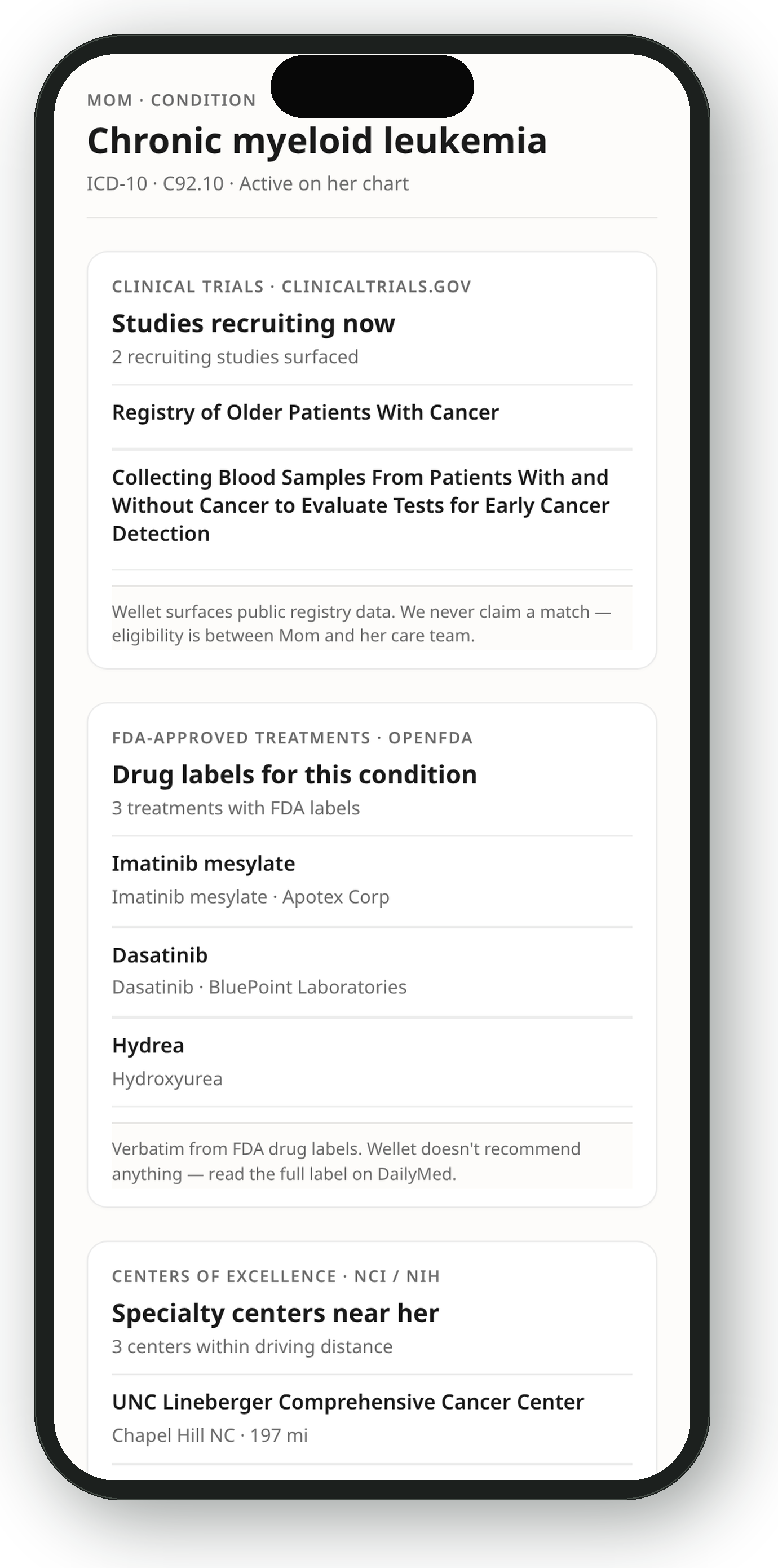
Tap a diagnosis and Wellet pulls the things a seven-minute visit usually skips — recruiting clinical trials, FDA-approved treatments, centers of excellence, patient-advocacy groups, and recent research — all grounded in your loved one's actual condition. Trials live this week. The rest land May 23.
Invite siblings, aides, and providers into one shared view. Everyone sees the same timeline. No more group texts or conflicting medication lists.
Capture the things only your loved one knows — how they want to be cared for, who they trust, the song at the end. Voice notes, in their own words, kept where the family will actually find them.
One tap, one PDF: the full chart, the care team, the patterns Wellet has noticed, and the wishes in their own words. Save it, share a private link with a sibling, or carry it into an appointment. Yours, not the hospital's.
Three views from the actual app: the everyday summary, the medication and wearable signals, and the depth that's waiting when you tap a condition.
Wellet Connect is a lightweight companion app for your loved one. They approve once, and vitals, medications, and records start flowing to your dashboard automatically.
Large text, three screens, one check-in button. Built for people who may not be tech-comfortable.
One approval screen. Revoke anytime. Read-only — Wellet never writes to their health records.
EHR records and medication check-ins flowing to your dashboard today. HealthKit vitals and wearables arriving soon.
Drop in a discharge summary, lab result, or medication list. Wellet reads it and builds a health timeline.
Link EHRs and wearables today — home sensors are coming soon. Data flows in automatically, and your care circle sees the same picture.
Get weekly summaries, pattern alerts, and plain-language answers. Know what changed and what to ask the doctor.
Build a plain-language health story for any window of time — chronological, in your loved one's voice, ready to read aloud at the next appointment or hand to a new specialist. Export to PDF or email it to yourself.
No ads. No data sale. Adding a loved one is free and so is connecting their hospitals — you watch Wellet pull records in before you pay. Then $10 unlocks that loved one's record for life. Ask Wellet and CareSignals, the AI that reads across the record and answers questions, is a separate subscription.
Looking for genomics, pedigree, or hereditary pattern scans? See Wellet Pro, our separate self-tracker product sold in credit packs.
Wellet connects to your patient portal through SMART on FHIR — the same secure standard hospitals use. Here's exactly what that means.
Wellet reads your health records from MyChart and other patient portals. We never write data back to your EHR. Your provider's records are never modified.
Every account is encrypted at rest (AES-256) and in transit (TLS). Row-level security means the database itself enforces that only you can access your data — not even Wellet staff can see it.
Invite family members to your care circle — or don't. Revoke access instantly. Export or delete everything at any time. There is no lock-in.
We don't sell your data, use third-party pixels, or work with data brokers. AI features process your data in real time and return insights — nothing is stored for training.
We publish live, anonymized usage data so researchers, medical professionals, and the public can see exactly how Wellet is being used — with zero personal health information.
Session counts, feature usage, and navigation patterns — updated in real time.
See which languages, devices, and regions Wellet caregivers come from.
No health records, no names, no IP addresses. Just aggregate patterns.

I designed the UX for Duke Health's first electronic health record system. I know how clinical data flows — and I know where it breaks for families.
When I became a caregiver myself, I saw the gap firsthand. Every health tool I tried was built for the patient or the provider. Nothing was built for the person in between — the one reading the discharge summary at 11 PM, trying to figure out if a medication changed.
That's Wellet. The tool I needed and couldn't find.
Wellet is a health companion built for family caregivers. It reads your loved one's medical records, follows their medications and health patterns, and tells you what's changing — in plain language. A record that belongs to your family, not the hospital.
Anyone caring for a loved one — whether you're managing a family member's medications, coordinating with siblings, or staying on top of your own health journey. Wellet works for caregivers at every stage.
You can upload documents like discharge summaries or lab results, and Wellet's AI extracts the important details. You can also connect directly to your loved one's electronic health records through supported patient portals — no manual data entry needed.
Yes. Your health data is encrypted and isolated with row-level security — no other user or even Wellet staff can access it. AI features process your data to surface insights without storing or training on anything. You own your data, you control who sees it, and you can export or delete it anytime.
Not required. Wellet works great with manual entry and document uploads. If you have caregiver proxy access to their portal, you can connect their records for automatic updates. Don't have proxy access yet? We put together a short walkthrough of how to request it from most major health systems — it's something you set up with the hospital directly, not through Wellet.
Wellet is free, forever, for caregivers. No tiers, no paywall, no credit card. We sustain it through foundation grants, mission-aligned partner licenses, and a separate product called Wellet Pro for self-trackers who want personal genomics, pedigree rendering, and hereditary scans (pay-per-use credit packs).
We publish a live, public dashboard showing fully anonymized usage data — things like which features caregivers use most, what devices they're on, and what languages they speak. No personal health information is ever included. We built it for researchers, medical professionals, and anyone who wants to see how a caregiving tool is actually being used.
No. Our analytics system collects only aggregate, deidentified usage patterns — session counts, feature taps, device types, browser language, and coarse timezone regions. We never collect names, IP addresses, health records, medications, or any personally identifiable information for analytics. Your health data stays encrypted and isolated in your account.
Wellet works with MyChart, not as a replacement for it. MyChart is built for the patient or the provider. Wellet is built for the person in between — the caregiver reading the chart at 11 PM trying to figure out if something changed. We pull data from MyChart and other portals through SMART on FHIR (the same secure standard hospitals use) and translate it into what you actually need to know. Care Circle lets you invite siblings, other caregivers, or providers into one shared view so everyone sees the same timeline.
Duke Health is live today. The Epic sandbox (a synthetic patient called Jason Argonaut) is connected for testing. We're adding new hospitals every week — if yours isn't in the list when you go to connect, you can request it from inside the app and we'll email you the moment it's ready. The VA is supported via VA Health Summary upload (not a direct connection — the VA hasn't built a caregiver proxy system yet). See the VA walkthrough.
Wellet Connect is an optional companion app that lives on your loved one's phone. They approve once, and their EHR records and medication check-ins start flowing to your Wellet dashboard. You don't need it — the main Wellet app works perfectly well with manual entry, document uploads, and your own connections to their patient portal (if you have proxy access). Connect is for situations where you want them in the loop too, or where they're managing their own care alongside you. Learn more about Wellet Connect.
A record that belongs to your family,
not the hospital.
Wellet is open. Start free today.